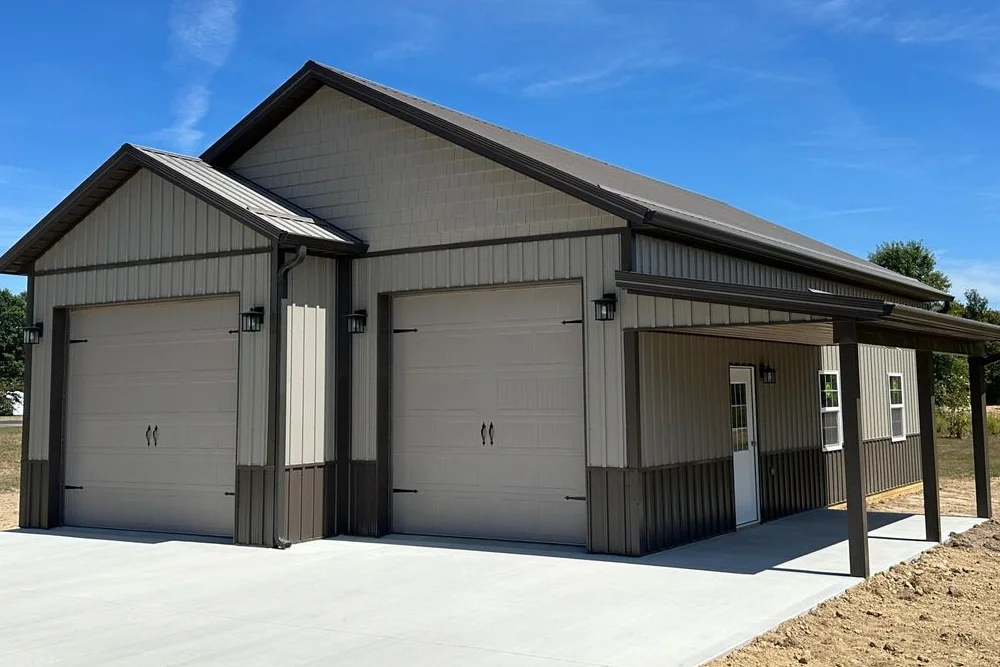
When people start planning a new building, they usually picture the finished space first. They imagine the wide-open workshop, or the clean-lined garage. But long before paint colors and finishes enter the conversation, there is a more important question sitting quietly underneath it all: what kind of structural system is going to hold this building together for the long haul?
That is where post and frame construction enters the picture. It is one of those terms people search when they are trying to make sense of the bones of a building. And honestly, that is a smart place to begin. According to the National Association of Home Builders, framing remains one of the largest cost components in a building project, which tells you something important right away. The structure is not a background decision. It shapes cost, performance, design flexibility, and durability from the very beginning.
If you have been wondering whether post and frame construction is the same thing as post-frame construction, how it carries loads, or whether it makes sense only for barns and utility buildings, you are not alone. These are some of the most common questions builders, property owners, and future homeowners ask. The good news is that once you understand how the system works, the appeal becomes pretty clear. Post-frame is efficient, flexible, and incredibly capable when it is properly engineered and built.
In everyday conversation, the phrase post and frame construction is often used to describe post-frame construction. In most cases, people are talking about the same basic system. The formal term used in the building industry is post-frame construction, but the search phrase “post and frame construction” is common because it sounds intuitive. People picture structural posts, a supporting frame, and a building taking shape around those major elements.
At its core, post-frame construction is a structural system that uses large vertical posts or laminated columns as the primary load-bearing members. Instead of relying on many closely spaced wall studs to support the roof and transfer loads down into the foundation, post-frame buildings use fewer but much larger structural members placed farther apart. Those posts work together with trusses, purlins, girts, and bracing to create a complete structural frame.
That difference may sound simple, but it changes almost everything about how the building performs and how the interior can be used. It is the reason post-frame buildings are often associated with wide open spaces, long spans, taller wall heights, and fewer interior obstructions. It is also why the system has expanded far beyond agricultural buildings and into residential, commercial, municipal, and mixed-use projects.
One of the best ways to understand post and frame construction is to look at how the building handles weight and movement. Every structure needs a reliable load path. That means there has to be a clear route for loads to travel from the roof all the way down to the ground.
In a post-frame building, the roof loads are carried by trusses or rafters. Those loads move into the structural posts or columns, and from there they transfer into the footing system, slab, piers, or foundation below. It is a direct and efficient path. Snow load, dead load, equipment load from roof-mounted systems, and other vertical forces all need to travel safely through that system without interruption.
Wind loads and other lateral forces are just as important. When wind pushes against a building, the structure needs to resist racking, uplift, and sideways movement. In post-frame construction, those forces are handled through a combination of diaphragms, connections, bracing, sheathing, and properly designed framing members. This is one of the reasons engineering matters so much. A post-frame building is not just a collection of posts standing in the ground. It is a coordinated structural system where every part needs to work together.
That is also why well-designed post-frame buildings perform so well. The system is built around clear structural roles. Major members handle major loads. Secondary members support cladding and help transfer forces. Connections tie the system together. When those elements are designed correctly, the building feels solid, efficient, and dependable.
If you are comparing structural systems, the most common point of reference is stick-built framing. That makes sense because stick-built construction is familiar. Most people have seen a house framed with rows of closely spaced studs, plates, joists, and rafters. It is a proven method, and it works very well for many applications.
Post-frame construction takes a different approach. Instead of relying on dozens of small wall studs spaced at regular short intervals, it uses large posts spaced much farther apart. Those posts carry the primary structural loads, while horizontal girts and roof purlins support the wall and roof systems between them.
This has a big effect on interior planning. In stick-built construction, the structural rhythm of closely spaced members often drives the layout. In post-frame construction, the wider spacing of major structural members creates more flexibility. Large bays are easier to achieve. Wide door openings are easier to accommodate. Interior spaces can often remain open without needing frequent bearing walls.
That is why post-frame has become so popular for workshops, storage buildings, riding arenas, and modern residential builds with open-concept layouts. The system gives owners room to work with. It does not force the interior into a tight grid.
There is also a practical construction advantage here. Because post-frame uses fewer primary structural members, the building process can be efficient and streamlined. That does not mean it is simple or casual. Good post-frame construction still requires solid planning, engineering, and workmanship. But it does mean the system can deliver a lot of usable space without the complexity of more repetitive framing methods.
One of the biggest strengths of post and frame construction is its ability to create long clear spans. This is often the feature that wins people over once they understand what the system can do.
A clear span means a large open area without interior support columns interrupting the space. In practical terms, that could mean a shop with room for equipment movement, a garage with fewer structural limitations, an event venue with a more flexible floor plan, or a residential great room that feels expansive instead of segmented.
This is where post-frame construction really shines. Because the primary structural supports are spaced farther apart and designed to work with engineered trusses, the building can cover substantial distances while keeping the interior open. That kind of flexibility is not just convenient. It can change the entire value of the building over time.
A structure that starts as storage may later become a workshop. A residential building may combine garage space, and hobby space under one roof. Long-span capability gives owners breathing room, both physically and functionally.
Of course, span capacity is never a guess. It depends on engineering, local design loads, member sizing, connection details, and building use. But when the design is done correctly, post-frame systems are exceptionally good at creating those large uninterrupted spaces people want.
Another common misconception is that post-frame buildings all look the same and are built from the same basic kit of materials. That is not really the case. While wood is usually the primary structural material, the system offers a surprising range of material options and finish possibilities.
The main structural posts may be solid-sawn or laminated columns, depending on the design requirements. Roof trusses are typically engineered wood trusses. Purlins and girts provide the secondary framing that supports the roofing and wall finishes. Those are the structural basics.
From there, the design can go in a lot of different directions. Exterior finishes can include steel panels, wood siding, fiber cement, stone accents, masonry veneers, stucco details, and other architectural materials. Roofs can be simple and functional or tailored to match a more finished residential or commercial appearance.
That material flexibility is a big reason post-frame has become attractive for more than barns and storage buildings.
People often ask whether post-frame construction is durable, and that question deserves a straight answer. Yes, it is durable when it is designed properly, built correctly, and matched to the conditions it will face.
Durability starts with engineering. A building has to be designed for its site, its loads, and its intended use. Wind exposure, snow load, soil conditions, moisture, foundation type, and occupancy all matter. The system performs best when the entire building is treated as a complete structural package rather than a simple shell.
Material selection matters too. Properly treated wood in the right locations, quality fasteners, good connection details, effective moisture management, and sound foundation work all contribute to long-term performance. So does workmanship. Even the best design can be undermined by poor installation, sloppy alignment, or weak detailing around openings and transitions.
The good news is that when post-frame construction is handled well, it has a reputation for strength and longevity. It is not a temporary or second-tier system. It is a serious structural method that has earned a place in a wide range of demanding building types.
This is one of the biggest questions in the market today, and it is easy to see why. More homeowners are exploring custom builds that combine open interiors, practical utility space, and modern aesthetics. Naturally, post-frame construction comes up in that conversation.
The short answer is yes, post-frame can absolutely be suitable for residential builds. In fact, it can be an excellent option for the right project. Homes built with post-frame systems can offer dramatic ceiling heights, wide-open common areas, large attached garages or shops, and flexible layouts that are harder to achieve with more conventional framing.
That said, residential post-frame construction is not just a matter of scaling up a barn and calling it a home. It needs to be designed for residential code requirements, insulation goals, energy performance, finish details, and everyday livability. The building envelope, mechanical systems, interior wall design, and overall comfort strategy all need to be considered carefully.
When done right, though, the results can be impressive. Post-frame homes are often chosen by owners who want a building that feels spacious, practical, and tailored to real life. It is a system that works especially well for people who need living space and functional space under one roof without sacrificing structural quality.
Post-frame construction performs best in projects where structural efficiency and design flexibility matter. That includes agricultural buildings, of course, but it extends far beyond that category.
Workshops and service buildings often fit naturally within the system because they need wide openings and usable interiors. Residential projects can benefit from the same structural logic when owners want open layouts and integrated utility areas.
The beauty of the system is that it does not force one kind of use. It supports a wide range of building goals. The key is matching the structural system to the needs of the project instead of choosing based on assumptions or old stereotypes.
That is where good planning comes in. A well-informed owner, builder, or designer can look at the use of the space, the desired span, the finish level, the site conditions, and the budget priorities, then decide whether post-frame is the right fit. Many times, it is.
A building always tells the truth about how it was planned. You can see it in the way the roof carries itself, the way the walls hold steady, and the way the interior either opens up naturally or feels boxed in from the start. That is why understanding post and frame construction matters. It is not just terminology. It is a way of thinking about how a building should work.
Post-frame construction offers a clear structural path, impressive span potential, material flexibility, and real durability when it is engineered and built the right way. It is not limited to one look, one use, or one type of owner. It is a versatile system that has earned its place in modern construction because it solves real problems with practical strength.
For anyone comparing framing systems, that is the big takeaway. Post and frame construction is not a shortcut. It is not an outdated method dressed up with a modern name. It is a capable structural system that deserves serious consideration, especially when openness, efficiency, and long-term performance are part of the goal. When the bones of a building are right, everything that comes after has a stronger foundation. And in construction, that is where every good story begins.
Let’s talk, plan and build something that feels like home.


