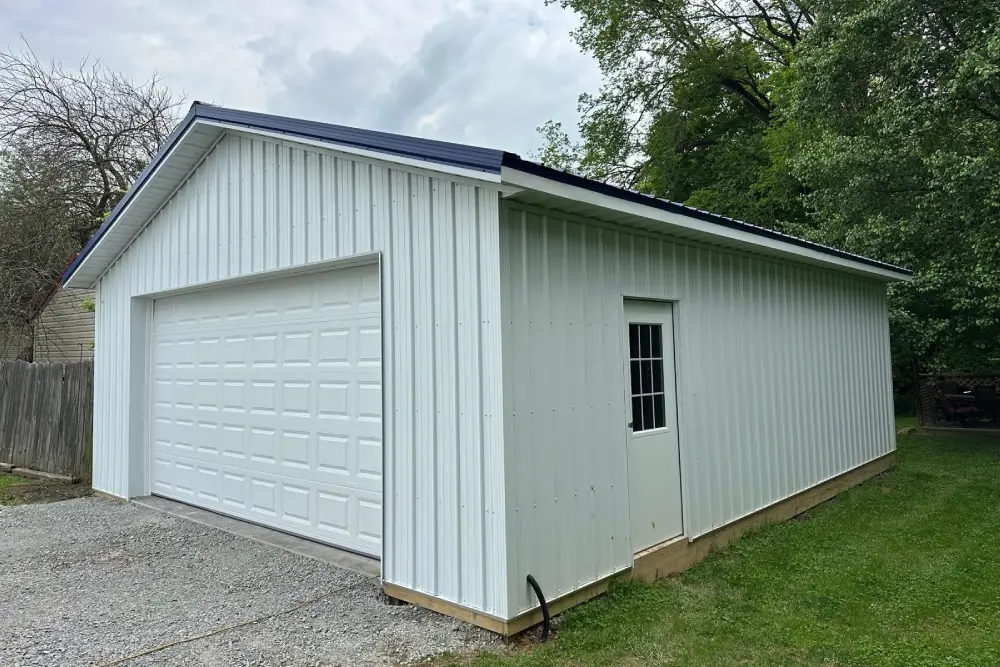
There’s a moment every Ohio property owner hits sooner or later: you’re standing out on your land, imagining the shop, the barn, the garage, the building that finally makes the place work the way you’ve always wanted it to. Then your eyes drift to the low spot that holds water after a storm, or the wind that comes ripping across an open field in February, and you think, “Okay… how do I build something that can handle all this?”
That’s the right question. Because in Ohio, the land and the weather aren’t background characters—they’re co-authors of your project. And if you want one simple statistic to keep you grounded from the start, here it is: the U.S. Geological Survey often notes that one inch of rain over a single acre equals roughly 27,000 gallons of water. Picture that much water trying to move across your site, around your building, and away from your slab or floor. Suddenly, soil prep and drainage don’t feel like “extra steps.” They feel like the foundation of your peace of mind.
This post is for Ohio property owners who are serious about building and want Ohio-specific clarity, not generic advice. We’re talking snow load ratings, wind resistance, soil preparation, drainage systems, and the regional inspection requirements that matter when you’re trying to get to the finish line and actually use the building. If you’ve been searching “post frame building Ohio,” “pole barns Ohio,” or “post frame construction Ohio,” you’re in the right place.
Ohio is a builder’s state in the best way—hardworking, practical, and diverse in conditions. You’ve got lake-effect snow potential in the northeast, open farmland wind exposure in the west and north, rolling terrain and mixed soils in central regions, and plenty of clay-heavy sites that behave very differently from sandy or gravelly ground.
That variety is exactly why “standard” plans can feel comforting but still miss the mark. A post frame building can be incredibly strong and efficient, but only when it’s designed for the loads and the ground it will actually face. In Ohio, that means thinking about winter snow events, wind-driven storms, freeze-thaw cycles, spring rain, and the way water travels across your specific property. Your building doesn’t just sit on land; it interacts with it every day for decades.
When people ask about snow load in Ohio, they’re usually asking one of two things, even if they don’t say it out loud. First, “Will my roof handle a bad winter?” Second, “What does the building department expect me to prove?”
Snow load is more than a single number. It’s a combination of how much snow can accumulate, how wind drifts it, how roof shape influences where it piles, and how cycles of melting and refreezing can create heavier conditions than a fluffy snowfall suggests. The load the roof is designed for is typically tied to code-adopted maps and standards, and a competent designer will consider the site location, roof pitch, roof geometry, exposure, and whether your building has features that create drift zones—things like porch roofs, lean-tos, stepped rooflines, or valleys that catch snow.
In practical terms, Ohio often includes areas where snow loads are moderate, but you can absolutely encounter higher design requirements in northern regions and snowbelt areas. That means the “same building” built in one county might need different engineering details than the “same building” built elsewhere. If your plan includes a wide span, a long roof run, or big open interior space with minimal interior support, snow load becomes even more important because the roof system is doing a lot of work.
For pole barns Ohio owners, the best move is to treat snow load as a design decision, not a guess. When a post frame building is engineered appropriately, the roof system, trusses, purlins, bracing, and connections work together so the loads have a clear, safe path down to the ground. That’s not just code compliance—it’s the difference between sleeping well during a heavy overnight snowfall and staring at the roof line wondering what you can’t see.
Ohio wind isn’t always dramatic, but it’s persistent, and it gets serious fast when storms roll through. The thing about wind is that it doesn’t just push against a building like a hand on a wall. Wind creates suction, uplift, and sideways forces that try to rack the building out of square. If your site is open, wind exposure can be more severe than people expect. If your building is near a ridge, on a cleared lot, or oriented in a way that catches prevailing winds, the design details matter even more.
Post frame construction Ohio projects handle wind well when the structure is designed as a system. That system includes diaphragm action in the roof and walls, proper fastening patterns, correctly sized bracing, and connections that resist uplift. Uplift is the sneaky one. Wind can try to lift the roof, peel panels, or stress connections at the eaves and corners—especially during gusty storms.
A strong post frame building in Ohio isn’t just about “bigger lumber.” It’s about correct load paths and correct connections. Trusses must be secured properly to bearing points. Posts must be anchored to resist uplift and lateral loads. Wall girts, sheathing (when used), and metal panel fastening schedules all contribute to stiffness and resistance. If you’ve ever seen a building that looks fine until you notice the walls have a slight wave or the corners don’t feel crisp, wind resistance and structural alignment are often part of the story.
If snow load is what the roof must survive, soil is what the whole building must trust. Ohio soils vary widely, but many sites deal with clay-heavy conditions. Clay can be strong when compacted properly, but it also holds water and expands and contracts with moisture changes. That movement can affect slabs, door alignment, and long-term performance if the base and drainage aren’t handled right.
Soil type affects more than just how hard it is to dig a hole. It influences how posts are supported, how footings bear load, how the site drains, and how much the ground may shift seasonally. Sandy soils behave differently than clay. Fill soil behaves differently than undisturbed native soil. A site that was graded years ago may have hidden layers that settle over time if they weren’t compacted in lifts.
The best Ohio builds start with honest site evaluation. That means looking at where water sits after a storm, checking for soft zones, understanding grade changes, and planning the building pad so it’s stable and properly compacted. If you’re pouring a concrete slab, the sub-base becomes a key structural element of the project’s longevity. A slab can look perfect on day one and still crack or settle if the base isn’t right.
This is where experienced builders separate themselves. Soil preparation isn’t glamorous, but it’s where we prevent the problems that homeowners hate the most—doors that stop closing right, floors that feel uneven, and the slow realization that the ground under the building wasn’t treated like it mattered.
In Ohio, drainage is not optional if you want a building that stays clean, dry, and usable year-round. Even a beautifully framed post frame building can be miserable if water collects around it, runs toward door thresholds, or finds its way under slabs.
Drainage starts with grade. The land around the building should encourage water to move away, not toward the structure. Then you’re looking at the building pad height relative to surrounding ground. A slightly elevated pad can make a huge difference in performance without making the building feel perched awkwardly.
From there, drainage is about control. Gutters and downspouts matter because they move roof runoff away from the base. Splash blocks or buried drain lines can keep that water from carving channels or saturating soil near the posts or slab edges. In some sites, swales or subtle contouring are enough. In others, you may need more robust solutions, especially if you’re building into a slope or you have heavy, slow-draining soils.
For residential pole barns and pole barn homes, drainage planning is even more important because the building isn’t just storage—it’s living and daily use. Wet entries, icy walkways, and musty interiors are the kinds of “small annoyances” that turn into constant frustrations. A good drainage plan helps prevent moisture-related issues, including condensation problems that can be worsened by damp conditions and temperature swings.
If you only remember one thing about drainage on a post frame building Ohio project, let it be this: water always wins the long game unless you give it a clear path to leave.
People love a simple answer to “Are engineered plans mandatory in Ohio?” The truth is that it depends on your jurisdiction, the building’s use, size, and classification, and what your local building department requires for permitting. Some areas are strict and want stamped engineered drawings for structural components. Others may allow prescriptive approaches for smaller accessory structures, but still require certain documentation.
Even when engineered plans aren’t explicitly required, they’re often the smartest choice—especially for larger buildings, buildings with big door openings, wide spans, porches, lean-tos, or any structure intended for residential use or occupancy. Engineering gives you defensible design for snow and wind loads, and it ensures your posts, footings, connections, and framing aren’t just “typical,” but appropriate for your location and your building’s specific configuration.
For post frame construction Ohio projects that are bottom-of-funnel serious—meaning you’re ready to build, not just browse—this is where you want clarity early. Permitting delays are one of the biggest avoidable stressors, and they often come down to missing documentation or mismatched expectations. When your plans align with the building department’s requirements from the start, the whole project flows smoother.
Inspections can feel intimidating if you’ve never built before, but they’re really just checkpoints. The building department wants to verify that the structure matches the approved plans and meets safety standards before critical parts get covered up.
In many Ohio jurisdictions, inspections commonly touch key phases like foundation or post hole conditions, structural framing, and any trade work such as electrical, plumbing, or HVAC if the project includes those. For a post frame building, inspectors often care about footing depth and size, post embedment or bracket anchoring details, framing alignment and bracing, truss installation, and connection hardware. If you’re building something that will be occupied, inspections can extend into insulation, fire safety considerations, egress requirements, and final occupancy approval.
The biggest “owner win” here is working with a builder who treats inspections as part of the plan, not a surprise event. When the schedule anticipates inspections and the work is done cleanly to spec, inspections become progress markers. When inspections are treated like an afterthought, they can become the thing that stalls the project at the worst possible time.
For bottom-of-funnel homeowners and property owners, this is the real question: “What inspections are required before occupancy?” If your project is intended for any kind of occupancy—whether it’s a pole barn home, a finished office space, or a building with conditioned interior use—your jurisdiction may require a final inspection and an approval step that confirms the building is safe for use. That can involve verifying completed structural work, required safety features, and any trades that were permitted.
Even if you’re not building a residence, some buildings still require final sign-off depending on size and use. The key is that occupancy is a legal and safety milestone, not just a personal feeling that the building looks ready. The smoother your documentation, inspections, and final details are, the faster you get to the part you actually care about—using the building without worry.
When someone calls us about a post frame building Ohio project, we don’t start by talking about siding colors or fancy upgrades. We start by talking about the site and the purpose. What are you building, how do you want to use it, and what does your land do during the worst week of the year? That last question matters more than people expect.
From there, we focus on designing for Ohio conditions instead of designing for “average.” We take snow and wind seriously, we plan drainage with intention, and we treat soil prep like it’s part of the structure—because it is. We also work to keep the permitting and inspection process clean and predictable, because that’s where first-time builders can feel overwhelmed. The goal isn’t just to get a building standing; the goal is to get you a building that performs, passes, and feels solid every time you open the door.
If you’ve been looking at pole barns Ohio options and trying to compare builders, here’s a simple way to tell who’s built for the long haul: ask how they handle site drainage and load design. If the answer is vague, you’re likely looking at a price, not a plan.
If you’re serious about moving forward with a post frame building in Ohio, the fastest way to protect your budget and your timeline is to get the fundamentals right early. Snow load design, wind resistance, soil preparation, drainage systems, and inspection planning aren’t “extras.” They’re what make the building feel solid, look straight, stay dry, and pass the approvals that let you use it with confidence.
When you’re ready, Dutch Builders can help you translate your site, your goals, and your local requirements into a plan that works in the real Ohio world—not just on paper. The best builds aren’t the ones that look good on day one. They’re the ones that still feel right after the tenth storm, the third freeze-thaw season, and the first winter that really tests everything.
Let’s talk, plan and build something that feels like home.


